

Los Angeles, CA · Services
IASTM in Los Angeles.
Instrument-Assisted Soft Tissue Mobilization (IASTM) uses a specialized metal instrument to find and treat soft-tissue restriction and scar tissue that a hand alone can miss, so overuse injuries move forward instead of stalling out.
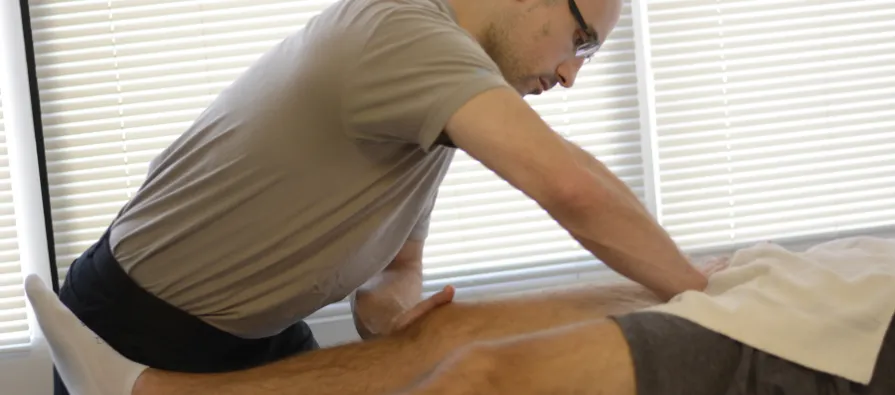
What is IASTM in Los Angeles?
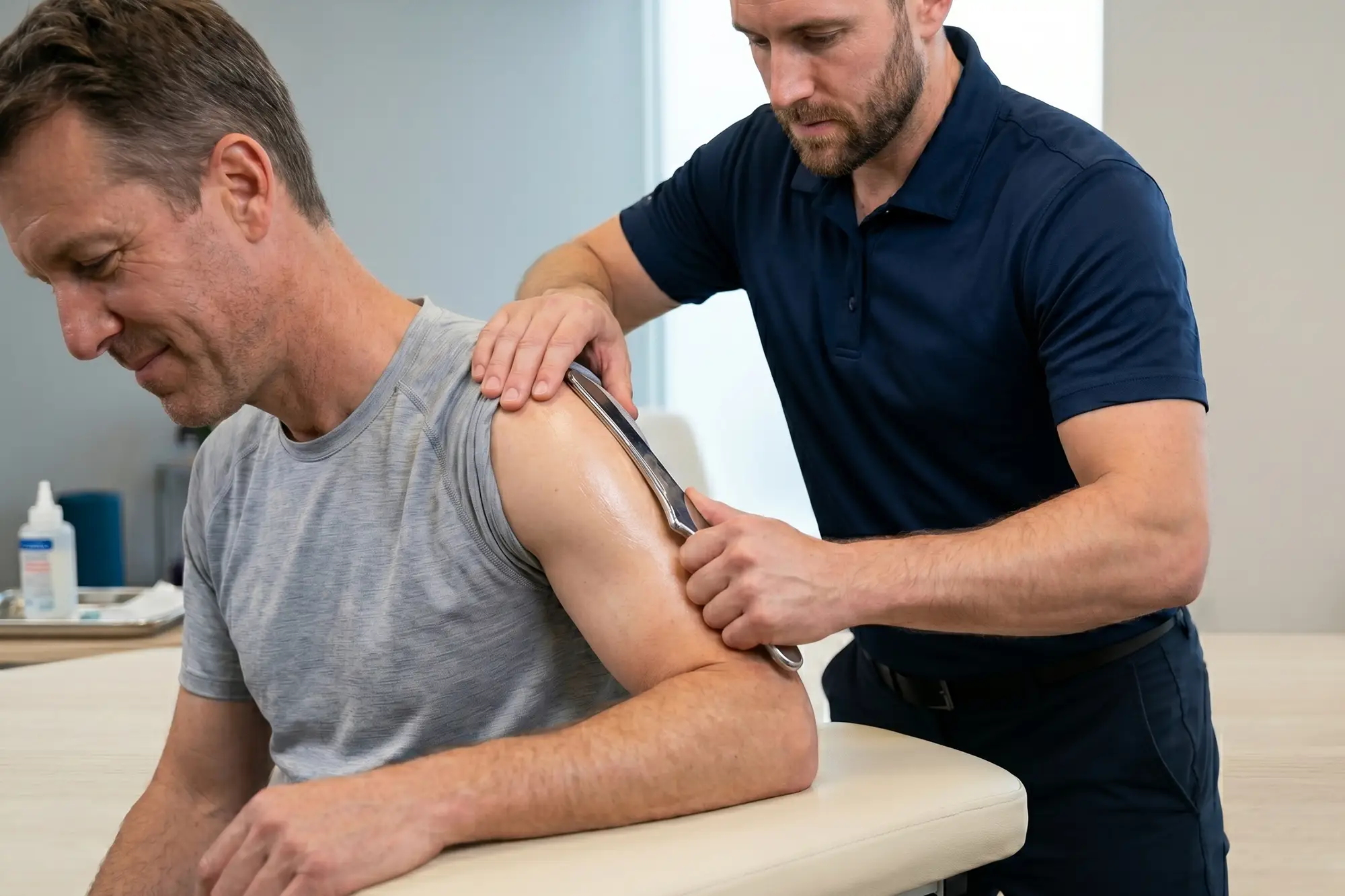
IASTM starts the same way every service here does: with a cause-first evaluation. Your physical therapist tests the area by hand first, then uses a specialized metal instrument, similar in shape to the Graston-style tools used across sports medicine, scanning it across the skin over the affected tissue. The edge of the tool catches on restriction and scar tissue that a hand alone tends to miss, so treatment goes exactly where the tissue has stopped gliding instead of guessing at the general area.
From there, every visit stays one-on-one with the same therapist, hands-on, for the full 40 minutes. IASTM is rarely the whole visit: it’s paired with manual therapy and loading work inside a plan that moves through four named phases, Pain, Prime, Perform, and Prevent, in that order, each with its own job and its own criteria for moving to the next one.
And the plan has an endpoint, named out loud at your evaluation, because the goal for an overuse injury is to get you back to full training, not to keep scanning the same tissue indefinitely.
Calm it down.
Hands-on treatment begins at the first visit. You leave understanding what’s actually going on, and you feel a difference early.
Restore what’s stuck.
Targeted mobility work for the joints and tissue actually holding you back, dosed to your body, not a printed sheet.
Build strength you trust.
Progressive load against standards you have to clear before moving on. Confidence, here, is a training effect.
Make it stay fixed.
Testing before you’re cleared, then a keep-it-gone program sized to your real week. Then we graduate you.
What conditions does IASTM treat?
IASTM is built for the overuse injuries that show up as one stubborn, scarred-down spot, the kind that stays put even after months of foam rolling and stretching. A sample of what it commonly addresses:
Elbow, wrist & hand pain ⟶
The grip and forearm tightness that flares every time training ramps back up.
02Knee pain ⟶
The tendon that’s stayed cranky since you added mileage or reps.
03Foot & ankle pain ⟶
The scar tissue from an old sprain that never fully let go.
04Shoulder pain ⟶
The overhead reach that catches on a knot instead of moving clean.
Left untreated, restricted soft tissue tends to compensate rather than resolve. It shifts load to the next joint up or down the chain, and it tends to keep flaring the same way every time training picks back up.
What does an IASTM session look like?
Your therapist starts by scanning the instrument across the skin over the area in question, feeling and listening for the catch that marks restricted tissue or an old scar. Once that spot is confirmed, the instrument works over it directly, angled to catch the fibers that need attention, while your therapist’s other hand stays on the tissue the whole time.
IASTM is rarely used alone. It’s typically folded into the same visit as hands-on manual therapy and movement work, so the tissue that just got mobilized is immediately put through the range and load it needs to hold. Mild redness or soreness over the treated area for a day or two is normal and expected, not a setback.
Who this is for, and who it isn’t.
IASTM tends to fit people carrying an overuse injury that hasn’t responded to rest, stretching, or time alone: tendinitis that flares every time training resumes, an old sprain with scar tissue that never fully let go, or the general soft-tissue stiffness of getting back into a sport after a break. It also fits older athletes working to return to full activity safely, where restricted tissue is often part of what’s slowing the comeback down.
The people who respond best to IASTM are usually the ones who’ve already tried the general fixes, the foam roller, the stretching routine, the rest, and still feel the same catch in the same spot. If that’s you, the instrument is built to find exactly what your hands haven’t been able to reach.
It’s not the right first stop for an acute fracture, an open wound, or a surgical incision that hasn’t fully healed over the area, or for a medical emergency. In those cases, get that addressed first, then come see us for the rehabilitation that follows.
Good fit
- An overuse injury that’s stalled despite rest, stretching, and time
- Scar tissue from an old injury that’s never fully resolved
- An older athlete working to get back to full training safely
- Restricted soft tissue confirmed at your cause-first evaluation
Not the right first stop
- An acute fracture, an open wound, or a surgical incision that hasn’t fully healed over the area
- A medical emergency, or a diagnosis your evaluation should follow rather than replace
It’s a tool inside the plan, never the whole plan.
“Jason is the most professional and skilled physical therapist and trainer. I cannot recommend anyone more highly.”Ellen F. · Google review
Questions, answered plainly.
Most people feel pressure and a mild scraping sensation rather than sharp pain, and it’s normal to see redness or light bruising over the area afterward that fades within a few days. Your therapist adjusts pressure to what your tissue can handle that day, and you can always ask for less.
The instrument itself makes the difference: its edge can detect restriction and scar tissue that fingers tend to slide past, and it applies a more precise, consistent pressure to a small area than manual pressure alone. It’s also delivered by a physical therapist inside a cause-first plan, not as a standalone relaxation service.
It depends on how long the restriction has been there and how it responds, not a fixed number. Most overuse injuries improve over several sessions folded into your regular visits, moving through the same four phases, Pain, Prime, Perform, and Prevent, as the rest of your plan, so IASTM tapers off once the tissue is moving the way it should.
Yes, that’s one of the more common reasons athletes, especially older athletes easing back into training, ask for it by name. Restricted soft tissue and old scar tissue are common reasons a comeback stalls, and clearing them alongside a progressive loading plan is exactly what the four phases are built to do.
Start with a cause-first evaluation.
Put it in writing.
Five short questions. Our virtual assistant typically responds the same business day but may take up to 24 hours.
The people who end up filling this out are rarely in the worst pain of their life. They’re just done working around it, done picking the errand that doesn’t require the stairs. If that’s the stage you’re at, this is the part where you stop researching and start.
Consider it filed.
Our virtual assistant typically responds the same business day but may take up to 24 hours. Keep your phone nearby.
Can’t wait? Call (424) 365-2083 ⟶Easy to find. Easy to park.
In the neighborhood, with parking half a block away. Come see the place before you commit, if you like.
The clinic · Jason Ferine Physical Therapy
Get Directions ⟶Opens in Google Maps