

Los Angeles, CA · Services
Manual tissue release in Los Angeles.
A hands-on soft-tissue technique that pairs direct pressure with your own active movement, built to break up the adhesions and scar tissue that keep a chronic, stubborn restriction from loosening on its own.
What is Manual Tissue Release in Los Angeles?
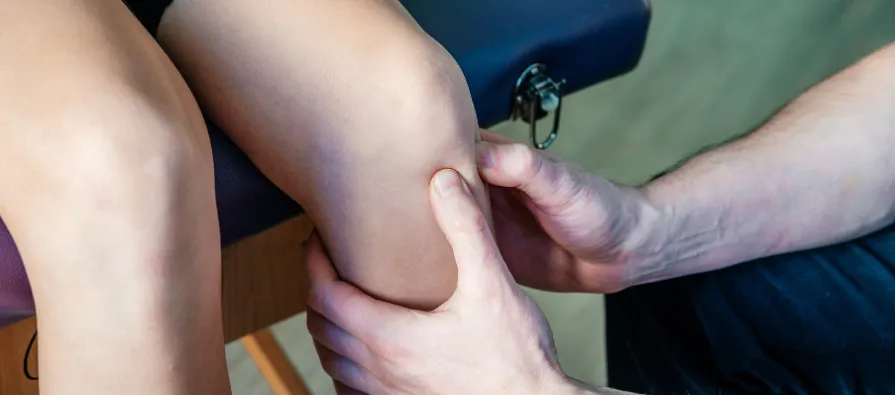
Manual Tissue Release starts with the same cause-first evaluation every plan here starts with: why this tissue is stuck, not just where it hurts. The technique itself is simple to describe and precise to apply. Your physical therapist applies direct pressure to the affected muscle, tendon, or fascia by hand, then guides you through an active movement of that same tissue, from short to full length, while the pressure holds.
That pairing, pressure plus your own motion, is what separates it from a general massage or a passive stretch. It’s built specifically for adhesions and scar tissue, the fibrous buildup that forms after an old injury, a surgery, or months of repetitive overuse, and that quietly binds muscle fibers together until a joint stops traveling through the range it used to have.
Manual tissue release is a tool inside a larger plan, not a standalone routine. Care still moves through four named phases, Pain, Prime, Perform, and Prevent, in that order, and the plan still has an endpoint named out loud at your evaluation, before you agree to anything.
Calm it down.
Hands-on treatment begins at the first visit. You leave understanding what’s actually going on, and you feel a difference early.
Restore what’s stuck.
Targeted release work for the adhesions and tissue actually holding you back, dosed to your body, not a printed sheet.
Build strength you trust.
Progressive load against standards you have to clear before moving on. Confidence, here, is a training effect.
Make it stay fixed.
Testing before you’re cleared, then a keep-it-gone program sized to your real week. Then we graduate you.
What conditions does Manual Tissue Release treat?
Manual tissue release is a targeted tool, not a general one, most useful where old adhesions or scar tissue are the actual restriction. A sample of what it commonly addresses:
Shoulder pain ⟶
The catching, half-frozen motion a shoulder holds onto long after the original strain healed.
02Elbow, wrist & hand pain ⟶
The repetitive-strain scar tissue that turns typing, gripping, or a swing into a slow burn.
03Low back pain ⟶
The old strain that never fully let go, and the stiffness that camps in the same spot every morning.
04Knee pain ⟶
The post-surgical scar tissue that keeps a knee from bending all the way, months after the incision closed.
Left alone, adhesions don’t resolve on their own. They tend to thicken with time and repeated use, narrowing the range you have left instead of restoring it, which is why a targeted release matters more the longer a restriction has been building.
What does a Manual Tissue Release session look like?
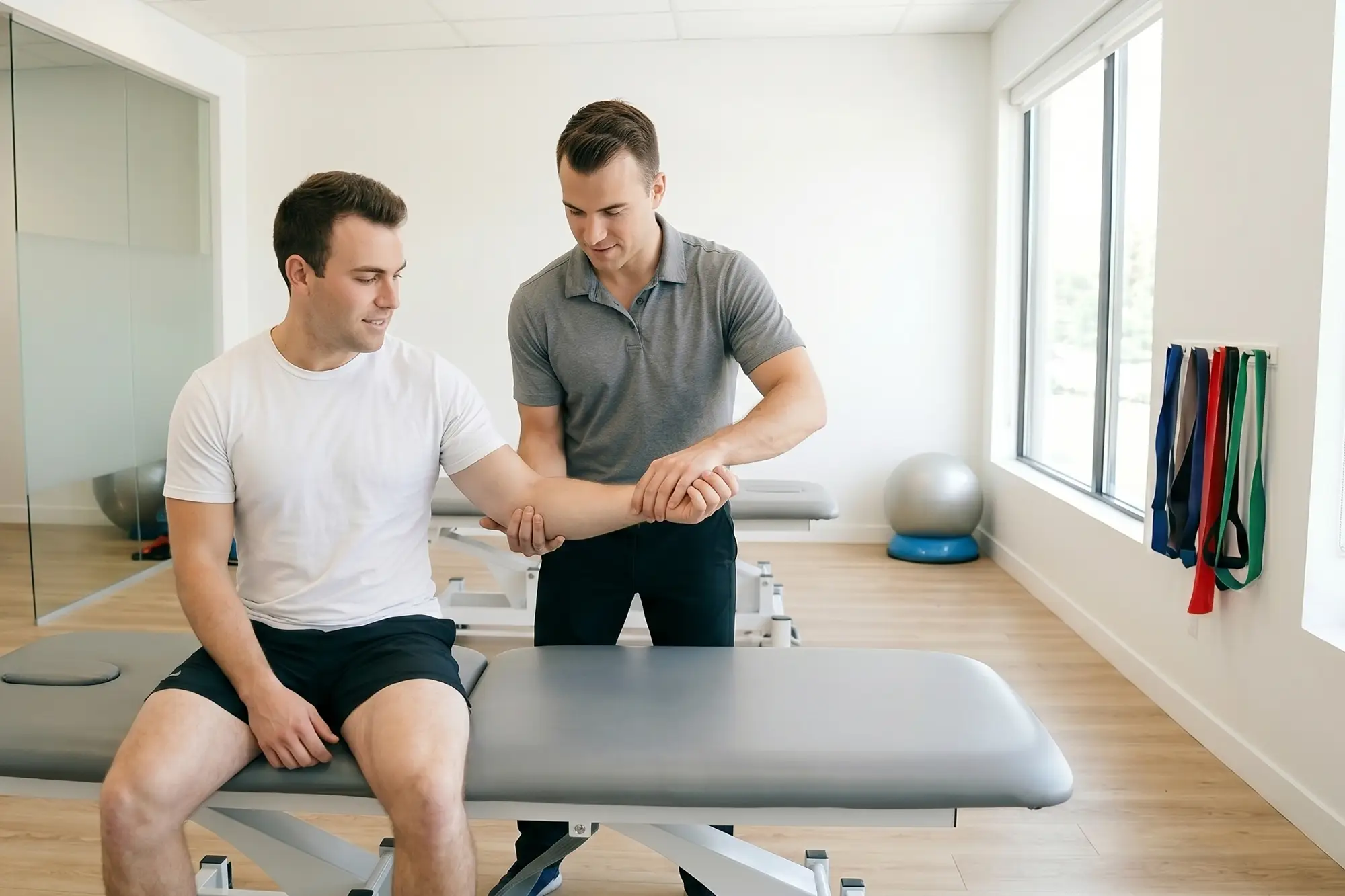
Your therapist finds the restricted tissue by hand first, testing the joint or muscle through its available range to locate exactly where motion stops early. From there, the release is applied directly: sustained pressure over the adhesion while you actively move that same limb through its motion, short to full length, so the tissue is worked from inside the movement, not around it.
Most sessions work a few related spots in the same visit, since a restriction rarely sits in just one place. You’ll feel exactly where the work is happening, and your therapist checks the range again afterward so you both see the change before you leave, not just feel like you should.
Who this is for, and who it isn’t.
Manual Tissue Release tends to fit people carrying a restriction that’s outlasted general treatment: a chronic knot that hasn’t loosened with movement and manual therapy alone, scar tissue from an old surgery that’s never let a joint finish its range, or a repetitive-strain adhesion that keeps returning no matter how often it’s stretched. It’s most useful once the cause-first evaluation has pointed at a specific, stubborn spot rather than a general ache.
The people who respond best to manual tissue release are usually the same type: something has been stuck for a while, other approaches have gotten partway there, and they want the actual adhesion addressed rather than worked around again.
It’s not the right first stop for an injury still in its early, inflamed stage, where gentle range comes before any targeted pressure, or for a diagnosis your evaluation should identify before tissue work begins. In those cases, your plan starts elsewhere first, then brings manual tissue release in once it’s the right tool for what’s left.
Good fit
- A chronic knot or restriction that hasn’t loosened with general manual therapy or movement alone
- Scar tissue from an old surgery that keeps a joint from finishing its range
- A repetitive-strain adhesion that keeps returning no matter how often it’s stretched
- Progress on an existing plan that has stalled at one specific spot
Not the right first stop
- An acute injury still in its early, inflamed stage, where gentle range comes first
- A diagnosis your evaluation should identify before any targeted tissue work begins
It’s a tool inside the plan, never the whole plan.
“Jason is an unbelievably knowledgeable, talented and efficient therapist and trainer. Can’t say enough good things about him.”Jim B. · Google review
Questions, answered plainly.
No. CA allows direct access to physical therapy, so you can book straight into an evaluation without a referral first. If manual tissue release turns out to be the right tool for what’s restricting you, your physical therapist works it into the plan from there. If your insurance requires a referral for reimbursement, we’ll flag that during your free benefits check.
It’s direct, and you’ll feel the pressure while you move through the motion, but it shouldn’t be sharp or leave you bruised. Most patients describe a strong, tolerable pull right where the tissue is stuck, easing as the adhesion releases within the same session.
The active part is the difference. A massage is passive, pressure applied while you stay still. Manual tissue release pairs that same hands-on pressure with your own movement of the joint or muscle, from short to full length, while the pressure holds, which is what actually pulls scar tissue and adhesions apart instead of just working around them.
It depends on how long the adhesion has been building and how it responds to the first release. Some stubborn spots loosen in one or two sessions, others need a few more worked into your broader plan, one of the four phases, Pain, Prime, Perform, and Prevent, that shapes your recovery either way. Your evaluation gives you a specific estimate before you start.
Start with a plan for what’s actually stuck.
Put it in writing.
Five short questions. Our virtual assistant typically responds the same business day but may take up to 24 hours.
The people who end up filling this out are rarely in the worst pain of their life. They’re just done working around it, done picking the errand that doesn’t require the stairs. If that’s the stage you’re at, this is the part where you stop researching and start.
Consider it filed.
Our virtual assistant typically responds the same business day but may take up to 24 hours. Keep your phone nearby.
Can’t wait? Call (424) 365-2083 ⟶Easy to find. Easy to park.
In the neighborhood, with parking half a block away. Come see the place before you commit, if you like.
The clinic · Jason Ferine Physical Therapy
Get Directions ⟶Opens in Google Maps