

Los Angeles, CA · Services
Manual therapy in Los Angeles.
Hands-on joint mobilization, muscle energy technique, myofascial release, and trigger point therapy: targeted manual work for the specific restriction your evaluation finds, delivered one-on-one by a physical therapist.
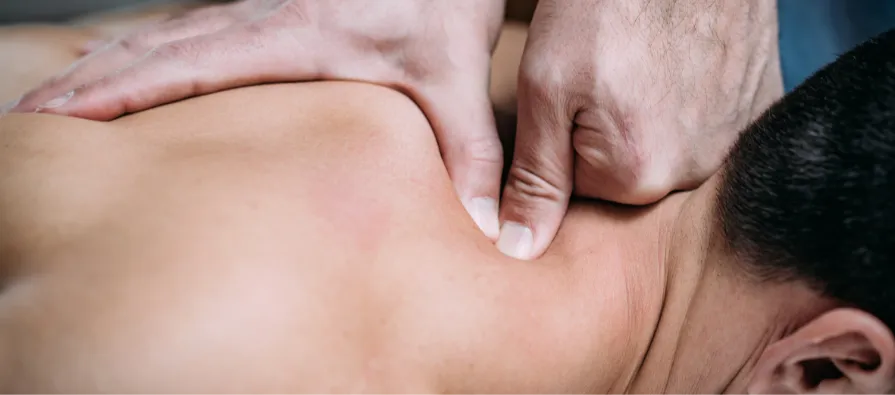
What is manual therapy in Los Angeles?
Manual therapy is hands-on treatment aimed at a specific restriction, not a general rubdown. It covers joint mobilization for a joint that has stopped moving the way it should, muscle energy technique for a muscle or joint that needs a precise, active correction, myofascial release for tissue that has guarded itself tight around an old injury, and trigger point therapy for the small, stubborn knot that keeps referring pain somewhere else.
It tends to go deeper and more targeted than a standard session on its own. Your cause-first evaluation is what points to it: when the exam finds a joint that will not move or tissue that is still guarding weeks or months after the original injury, manual therapy is the direct, hands-on answer to that specific finding, not a routine add-on.
That is also why it is delivered one-on-one by a physical therapist, the same one, every visit. The techniques above ask for a trained pair of hands and continuous judgment about how much a given joint or tissue can take that day. Care still moves through the same four named phases, Pain, Prime, Perform, and Prevent, in that order, and manual therapy is dosed to whichever phase you are in.
Calm it down.
Hands-on treatment begins at the first visit. You leave understanding what’s actually going on, and you feel a difference early.
Restore what’s stuck.
Targeted mobility work for the joints and tissue actually holding you back, dosed to your body, not a printed sheet.
Build strength you trust.
Progressive load against standards you have to clear before moving on. Confidence, here, is a training effect.
Make it stay fixed.
Testing before you’re cleared, then a keep-it-gone program sized to your real week. Then we graduate you.
What conditions does manual therapy treat?
Manual therapy shows up anywhere the evaluation finds a specific joint or soft-tissue restriction, which puts it in play across most of the regions we see. A sample of what it commonly addresses:
Low back pain ⟶
The segment that will not rotate and the guarding that keeps bracing before you even bend.
02Neck pain & headaches ⟶
The upper joints that have lost their glide and the base of the skull that stays tender to the touch.
03Shoulder pain ⟶
The capsule that has quietly tightened and stolen the last few degrees of reach overhead.
04Hip pain ⟶
The deep guarding around an old strain that stretching alone never seems to reach.
05Elbow, wrist & hand pain ⟶
The tissue that has thickened and guarded itself around a grip that will not fully relax.
Left alone, a joint restriction or a guarded band of tissue rarely resolves on its own. Movement compensates around it, other joints pick up the slack, and the original restriction tends to stay parked exactly where it started until something goes to work on it directly.
What does a manual therapy session look like?
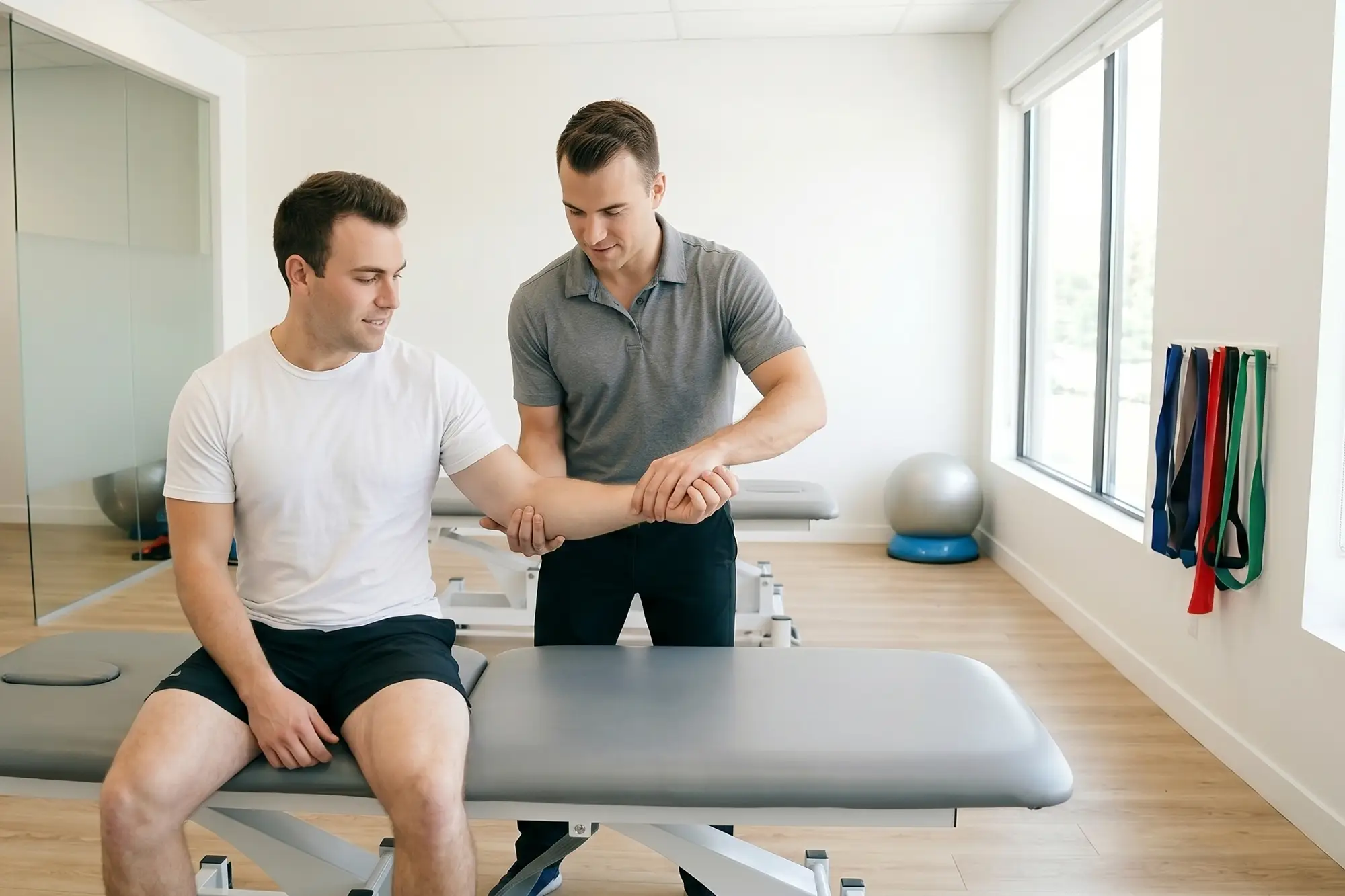
If manual therapy is called for, it is identified at your cause-first evaluation, where your therapist tests the joint or tissue in question and explains what the restriction is and why it is there. Hands-on treatment starts that same visit: the specific technique, whether joint mobilization, muscle energy technique, myofascial release, or trigger point work, is matched to the specific finding, not applied as a blanket routine.
Follow-up visits open with a quick check on how the area responded, then return to hands-on work where the restriction still is, followed by movement to reinforce the range you just gained. Your therapist stays in the room the whole time, adjusting pressure and technique to what your tissue tells them that day, and you leave knowing what loosened and what today’s work was building toward.
Who this is for, and who it isn’t.
Manual therapy tends to fit people whose evaluation turns up something specific: a joint that has stopped moving the way it should, tissue that is still guarding around an old injury, or a stubborn knot that keeps referring pain somewhere else and has not responded to movement alone. It is often layered into an existing plan rather than booked on its own, though a focused course of hands-on work can also stand alone once the cause is clear.
The people who get the most from it are usually dealing with something that has resisted the generic advice: stretch it, ice it, wait it out. If that sounds familiar, a pair of trained hands finding and working the actual restriction is often the missing piece.
It’s not the right first stop for a medical emergency (chest pain, sudden numbness or weakness, a fracture that needs to be set) or for a diagnosis your evaluation should follow rather than replace. In those cases, call your physician or go to urgent care first, then come see us for the rehabilitation that follows.
Good fit
- A joint that has stopped moving the way it should
- Tissue that is still guarding around an old injury
- A stubborn knot that keeps referring pain and hasn’t responded to movement alone
- Wanting focused hands-on work layered into, or alongside, your plan
Not the right first stop
- A medical emergency: chest pain, sudden numbness or weakness, a fracture that needs to be set
- A diagnosis your evaluation should follow rather than replace
It’s a tool inside the plan, never the whole plan.
“Jason is a highly experienced and knowledgeable physical therapist who has successfully helped me recover from my injury.”Nora W. · Google review
Questions, answered plainly.
No. A massage is general relaxation work over a broad area. Manual therapy is targeted treatment of a specific joint or soft-tissue finding from your evaluation, using techniques like joint mobilization, muscle energy technique, myofascial release, and trigger point therapy, delivered by a physical therapist as part of a plan with an endpoint.
No. CA allows direct access to physical therapy, which means you can book a cause-first evaluation without seeing another provider first. If your insurance requires a referral for reimbursement, we’ll flag that during your free benefits check and help you get one before it holds anything up.
For most patients, it’s layered into the plan: your evaluation finds a specific restriction, manual therapy addresses it directly, and movement work in the same visit reinforces the range you gained. Some patients book a focused course of hands-on work on its own once the cause is clear, but it’s always guided by an evaluation, not offered as a stand-alone service with no exam behind it.
During treatment, expect pressure and stretch at the specific joint or tissue being worked, sometimes brief discomfort as a guarded area is addressed directly, but not sharp pain. Afterward, many patients feel looser through the treated area and notice new range of motion the same day, occasionally with mild soreness, similar to how a muscle feels after being worked hard, that settles within a day or so.
Start with a cause-first evaluation.
Put it in writing.
Five short questions. Our virtual assistant typically responds the same business day but may take up to 24 hours.
The people who end up filling this out are rarely in the worst pain of their life. They’re just done working around it, done picking the errand that doesn’t require the stairs. If that’s the stage you’re at, this is the part where you stop researching and start.
Consider it filed.
Our virtual assistant typically responds the same business day but may take up to 24 hours. Keep your phone nearby.
Can’t wait? Call (424) 365-2083 ⟶Easy to find. Easy to park.
In the neighborhood, with parking half a block away. Come see the place before you commit, if you like.
The clinic · Jason Ferine Physical Therapy
Get Directions ⟶Opens in Google Maps